
Getting Fruity & Going Nuts: Trees in September

What comes to mind when you think of September? I think of birds migrating, shorter days, late summer wildflowers, and maybe even some early fall color.
I think of quiet nights. The woods can feel a bit lonesome now that most frogs, katydids and nightjars are no longer calling. Fortunately there are still crickets calling to fill in the gaps.
I also think of trees - especially the fruit found on trees.
I've always been fascinated by the variety of fruit produced by trees: the different sizes, shapes, textures, colors, and tastes. As someone who's into wild edibles and fall foraging (and eating!), I'm especially interested in taste. Fortunately many trees in our area produce edible fruit.

September is the perfect month to examine tree fruits before they fall to the ground, disperse their seeds, wither away or are eaten by the wildlife. Let's take a look at some you might see in Tennessee.
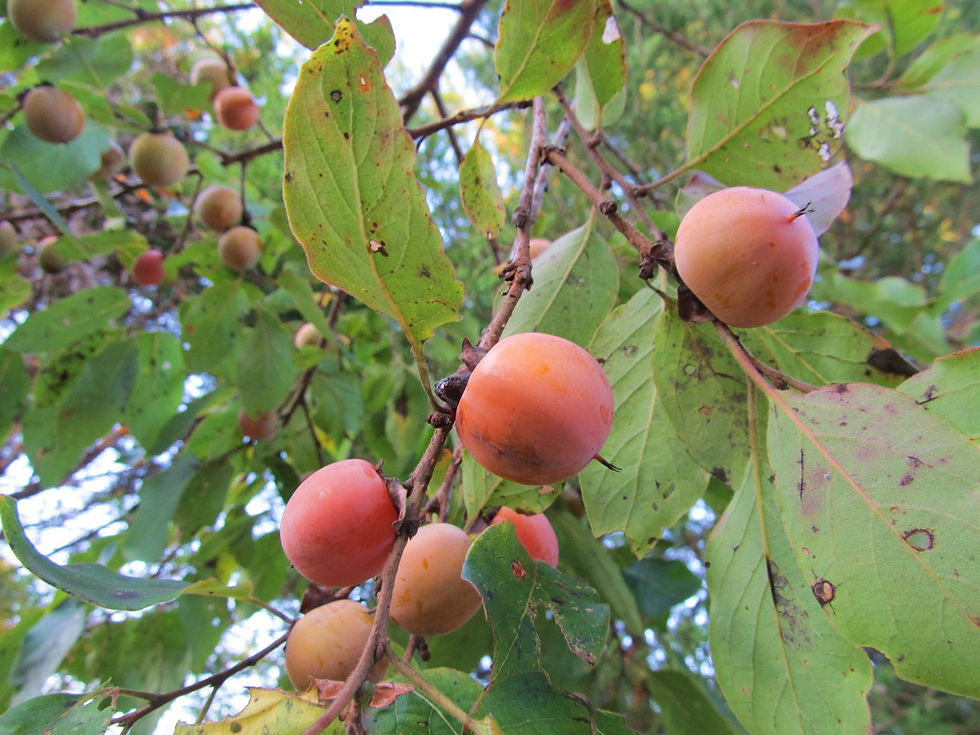
One of the most well-known tree fruits in our area is produced by the Common Persimmon. I saw a few ripe ones in August, but there should be many ready to devour in September.
Common Persimmon (Diospyros virginiana) is a small to medium-sized tree with blackish bark that is broken into small, conspicuous blocks - similar in appearance to an alligator's back. It is highly adaptable and will thrive almost anywhere. The fruit is extremely astringent when green, and I'm sure many of you have had the unfortunate experience of eating an unripe persimmon! But the fruits are edible and sweet when they soften and turn reddish-orange in the fall.
Ripe persimmons can be used to make puddings, cake, bread, and beverages. Yum, it doesn't get much better than a good persimmon cake! Sometimes I make persimmon leather by gathering fruit, mashing it up, spreading it in a large pan, and then drying it out in an oven on low heat. It makes for healthy and tasty dried fruit hiking snack.
Persimmon is an important food for opossums, raccoons, skunks, deer, foxes, and birds. The roasted seeds have been used as a substitute for coffee, and its flowers are useful in the production of honey. The genus name Diospyros, from the Greek, means fruit of the god Zeus. If that doesn't impress you, then I'm not sure what will!
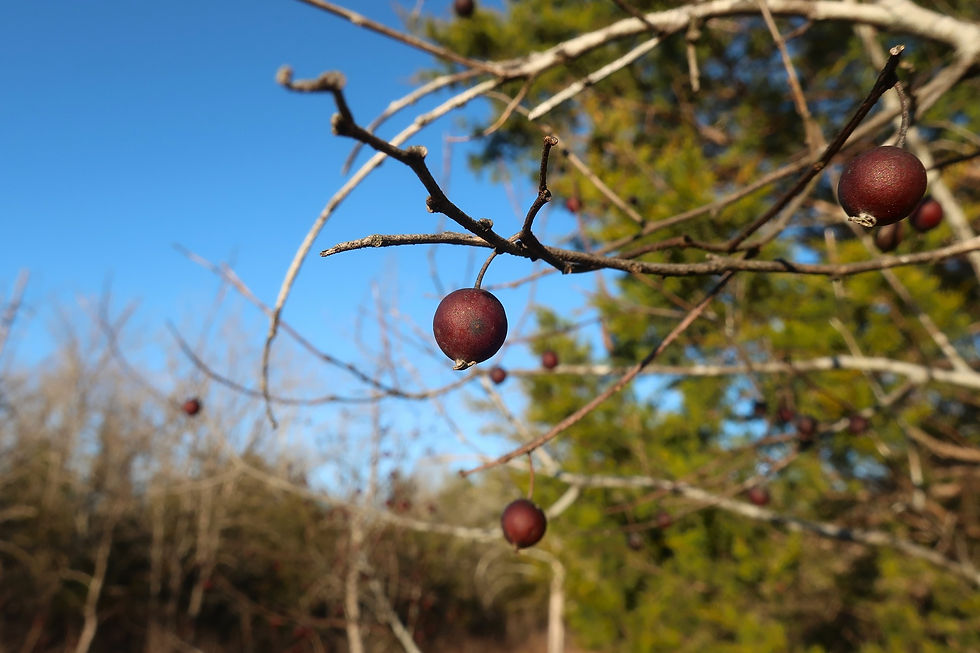
It's not a well-known species, but one of my favorite native trees is Rusty Blackhaw (Viburnum rufidulum). This small, unique tree has glossy, dark green, finely toothed leaves, and its leaf stems are clothed with a dense, rusty-red pubescence. The foliage turns rich reddish purple in the fall. The bark typically separates into dark, rectangular plates, similar to dogwood. It produces clusters of showy, creamy-white flowers during spring.
Small blue/black fruits with a waxy coat appear in autumn. These sweet, edible fruits hang from the tree in clusters and are relished by birds and small mammals - and also by me! They're nicknamed "wild raisins," which gives you a clue to what they taste like.
Often used in wildlife gardens, Rusty Blackhaw can form thickets under favorable conditions. The Latin name rufidulum, meaning reddish, also refers to the hairs on the stems. They prefer rich, moist bottomlands. Most fruits I've seen lately are still green or slightly reddish, but once they turn dark, give them a try. That is, if you can find them before the birds devour them all.

Carolina Buckthorn (Rhamnus caroliniana) is a common species that can be found at the edge of the woods and along trails. It's a small tree with elliptical, glossy, dark green leaves that often stay green into late fall.
The yellowish flowers are tiny and rather inconspicuous, but the round, berry-like fruits are showy, starting out bright red and then turning black as they ripen in autumn. The ripe fruits are a source of food for many songbirds, including mockingbirds, catbirds and brown thrashers, but unfortunately they are inedible to humans.
This tree's brilliant fall foliage is yellow to yellow-orange and often lasts into the winter. Also known as Indian Cherry, it is unusual among the buckthorns in that it does not actually have thorns. It prefers limestone soils, but will grow almost anywhere and is usually an understory tree.

Next on my list is Roughleaf Dogwood (Cornus drummondii). It doesn't get as much attention as its more showy cousin, the Flowering Dogwood.
Roughleaf Dogwood is a small tree with flat-topped clusters of creamy-yellow flowers and hard, white fruit on reddish brown twigs. The upper surface of the leaves is covered by short, stiff hairs, giving it a rough feel and thus its name. It's uncommon in the wild and mostly found around forest borders. It sometimes forms dense thickets that are used as a hedge, border, or as cover for wildlife.
At least forty species of birds feast upon Roughleaf Dogwood fruit, which ripens in late summer. The fruits are inedible to humans, but I wouldn't want to eat them anyway because, well... they look like little eyeballs. So it's kinda fitting that these odd-looking fruits are prominent during the Halloween season.

Black Cherry (Prunus serotina) is the largest of the native cherries, growing 60 to 80 feet tall. As the tree ages, the dark bark exhibits a scaly or flaky pattern, giving it a "burnt corn flakes" appearance.
In spring, the small, fragrant white flowers mature. The flowers are followed by drooping clusters of small red cherries that ripen in late summer to dark purple-black. The fruits are edible but bitter when fresh off the tree and can be used to make jams, jellies and wine.
Wild cherry syrup, a cough medicine, is obtained from the bark. The crushed foliage and bark have distinctive cherry-like odor and bitter taste. They have alternate leaves with a finely toothed margin, inconspicuous glands on the stem, and yellow-brown pubescence on underside of leaf. The foliage turns attractive shades of yellow and rose in fall.

Hackberry (Celtis occidentalis) doesn't get much respect. Probably because they have weak wood and drop branches easily. And attract messy aphids. And have "warts" all over their bark. And attract birds which eat their fruit and drop seeds everywhere - including on car windshields. However, I've always been fond of them. One of the most abundant trees in our area, this member of the elm family is recognized by its corky, wart-like projections that cover the bark on older specimens. It's tolerant of a wide range of habitats and you might find it anywhere - even in the thin soils of limestone glades. Hackberry has a rounded crown of spreading or slightly drooping branches, often deformed by bushy growths called witches'-brooms, which are produced by mites and fungi. The leaves often bear rounded galls caused by tiny jumping plant lice. These trees produce small edible purplish berries which are consumed by cedar waxwings, mockingbirds, robins, and many other birds. The common name was derived from hagberry, meaning marsh berry, a name used in Scotland to describe a cherry.
Many folks are surprised when I tell them that ripe hackberries are tasty. Honestly, there isn't much to them - the fruits are tiny and it's mostly seed. But when ripe, I think they taste like candy. It's a shame there isn't more pulp to them because I think a hackberry pie or hackberry shaved ice would be delicious.
On the opposite end of the spectrum, I think everyone loves Eastern Redbud (Cercis canadensis). Often planted as an ornamental, this small, short-lived tree is found throughout Tennessee. It stands out in early spring because of the striking, bright pink flowers that emerge before the leaves appear.
The edible flowers can be eaten raw in a salad, or fried. Its flowers are important in the production of honey by bees. Redbud is easily recognized by its smooth, heart-shaped leaves. It's typically an understory tree preferring moist, well-drained sites.
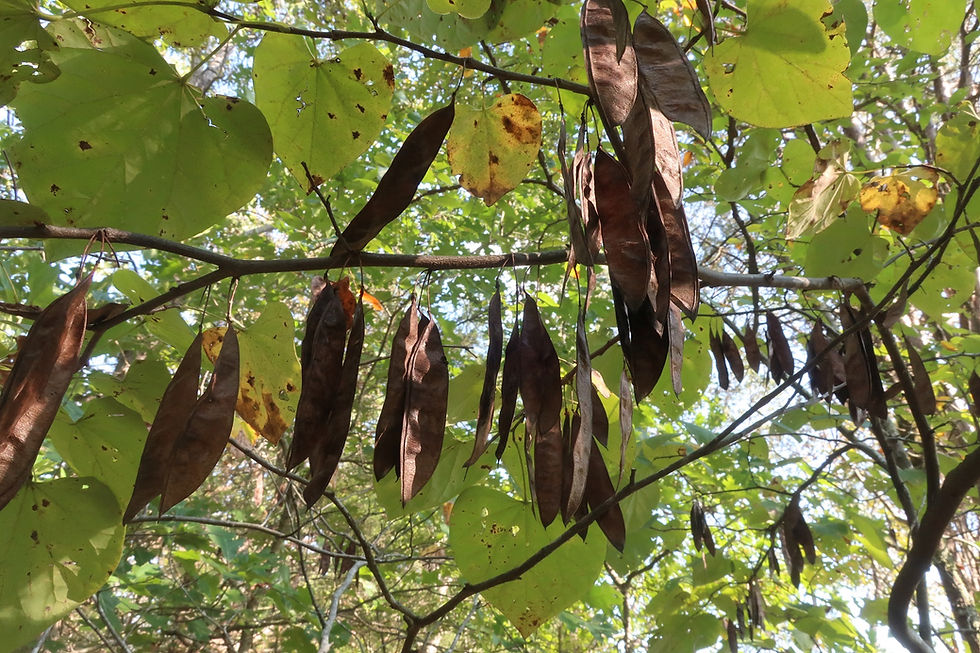
The fruits of Eastern Redbud stand out at this time of year and can be seen hanging from branches in the understory. Their long flat pods, which are green (and edible) during spring, turn brown in the summer. These pods contain bean-like seeds. The fruits often remain on the tree throughout winter, making them a valuable wildlife food.
If you're a raccoon (or a human), one tree you might wanna avoid climbing is a Honey Locust (Gleditsia triacanthos). These trees often have long, needle‑sharp thorns on its trunk... ouch! The strongly scented cream-colored flowers appear in late spring, and the fruit - a long, flat, bean-like pod called a legume - matures in the fall. The pods look similar to Eastern Redbud but are usually larger and sometimes slightly curved.
The sticky, honey-like pulp inside the fruit, called locust bean gum, is edible and sweet, and is used in candies. If you're hiking and find some freshly fallen Honey Locust pods on the ground, consider yourself lucky. Its pulp is one of nature's best desserts! Honey Locust seeds are fed upon and dispersed by grazing cattle and horses. Thus, it's often found along fencerows where it is overlooked and allowed to grow. The tree is a good source of honey during the short flowering period in spring.
When looking for this species, keep an eye out for the sharp thorns on the trunk and the long, hanging pods during autumn.
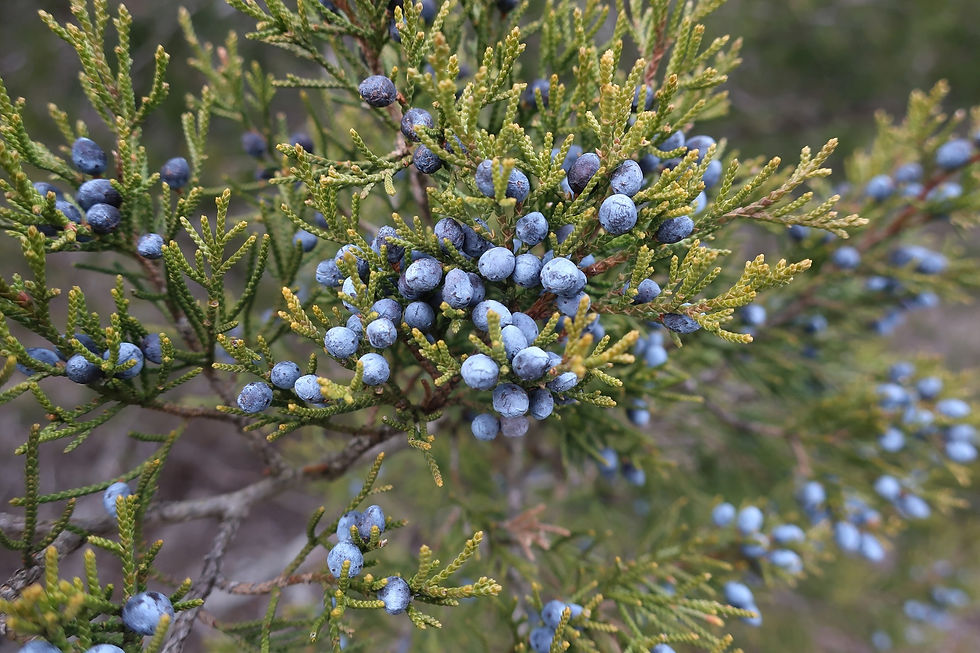
Most Tennesseeans are likely familiar with Eastern Redcedar (Juniperus virginiana). Kids may know them better as "Christmas trees." This aromatic conifer is one of the most common species where I live, and it is the only native evergreen found in my area.
Fun fact: The pale blue fruits of Eastern Redcedar (often called juniper berries) are actually a type of cone. The fruits occur on female trees and are an important winter food for many songbirds, which disperse the wingless seeds.
This species provides food for wildlife, nesting and roosting for birds, and protective vegetation for fragile soils. It's a super tough tree and is resistant to extremes of drought, heat and cold.
The fine-grained, soft, brittle, pinkish heartwood is fragrant, light and durable. Because of its rot resistance, the wood is used for log cabins and fence posts. The aromatic heartwood is avoided by moths and thus is in demand as lining for clothes chests and closets.
A few other of our native trees have circular fruits that range in size from a ping pong ball to a softball.
Sweet Gum (Liquidambar styraciflua) is known for its star-shaped leaves and its spiky, globe-shaped fruit. The branches and twigs sometimes have corky wings, similar to Winged Elm. The common name refers to the aromatic "gum" that oozes from wounds to the tree. Historically, this gum was used medicinally as well as for chewing gum.
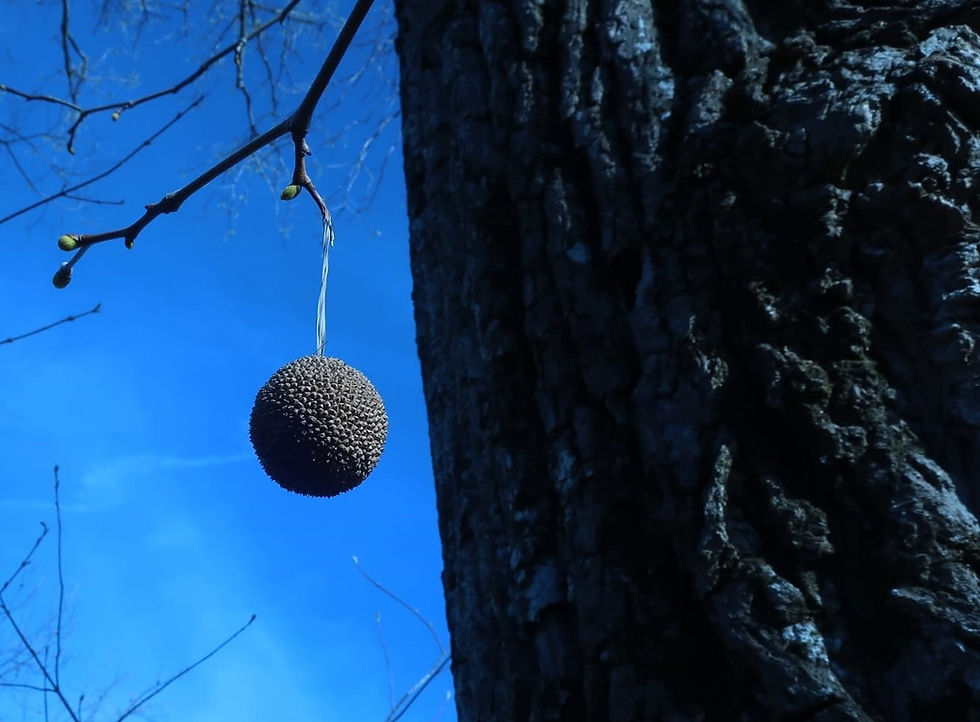
The globular fruit of American Sycamore (Platanus occidentalis) often hangs on the tree throughout the winter and then starts to break up and spread their seeds during the spring. These trees are easily recognized by their brown and white mottled bark, which becomes totally white on the upper trunk and branch surfaces, giving it the name “ghost tree.” It's one of the tallest deciduous trees in the U.S. and commonly found growing along streams, lakes and ponds.
Black Walnut (Juglans nigra) has large, hard-shelled nuts enclosed in a green husk, which becomes darker when ripe. The nuts are widely used in cakes, candies and ice cream, while the husks are used to make walnut furniture stain. It's an important food for wildlife. To spot this species, look for dark, furrowed bark, long leaves consisting of 5-11 pairs of leaflets, and large round husks hanging from branches during autumn.
Osage Orange (Maclura pomifera) is a gnarly-looking tree - rough, twisted, densely branched, misshapen, thorny, and with huge, green softball-sized fruits that have been nicknamed "monkey brains." This species is also known as Hedgeapple, Bow Wood and Bodark (or Bodock). The fruits have a milky juice that is sticky, bitter and inedible, and the bark often has an orangish tint. The tree is extremely drought tolerant, and the strong wood was once used by Native Americans to make bows for their arrows.
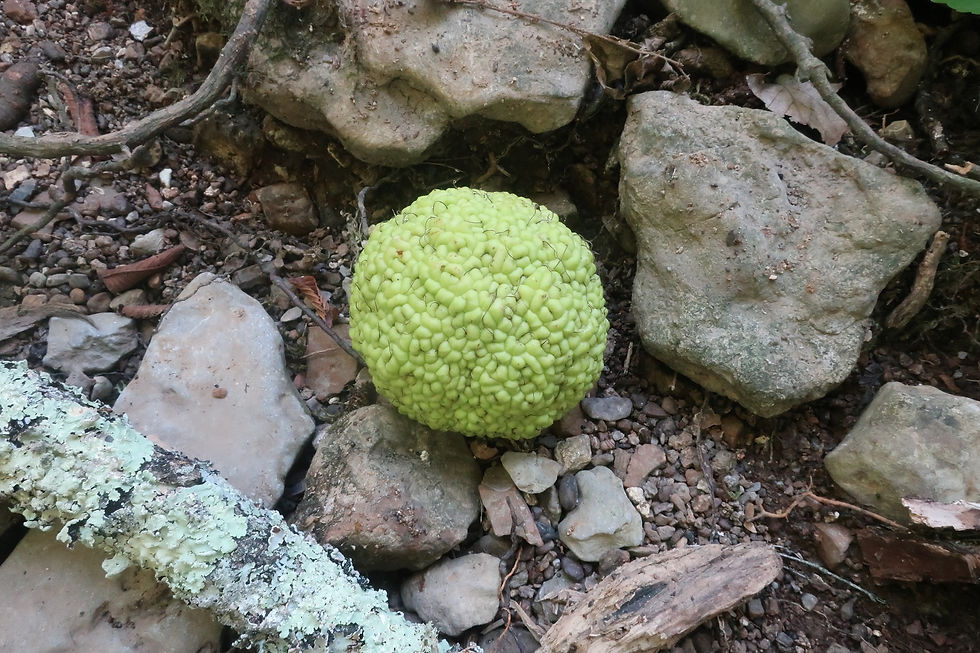
It's interesting to note that Osage Orange fruit, along with those of the Honey Locust and Kentucky Coffeetree, belong to a class of evolutionary anachronisms. The large land mammals that they co-evolved with, and that formerly distributed their seed, have all gone extinct.
One of the most distinctive acorns in of all Tennessee trees can be found on Bur Oak (Quercus macrocarpa). These mighty trees often have a massive trunk to go along with their low, large, spreading branches. They are more common in the Midwest, but you can occasionally find them in Tennessee. They grow on both moist and dry sites, and you will often see them growing singly.
Bur Oak's fiddle-shaped leaves are certainly unique, as are their striking fruits. The acorns have unusual, very deep fringed cups, and are the largest acorns of all native oaks.

Common Hoptree (Ptelea trifoliata) is a little-known tree but is worth seeking out because it is a host plant for our beautiful Giant Swallowtail butterfly. Their caterpillars look similar to bird droppings. A pretty good deterrent, I would say!
A member of the citrus family, Common Hoptree is also known as Wafer Ash. This is a good time of year to find their fruit, which is similar to that of elms but a bit more showy. The common name "hoptree" comes from the fact that the flat round fruits can be used as a substitute for hops in the brewing process.

Did you know that the largest edible fruit native to North America is... the pawpaw?
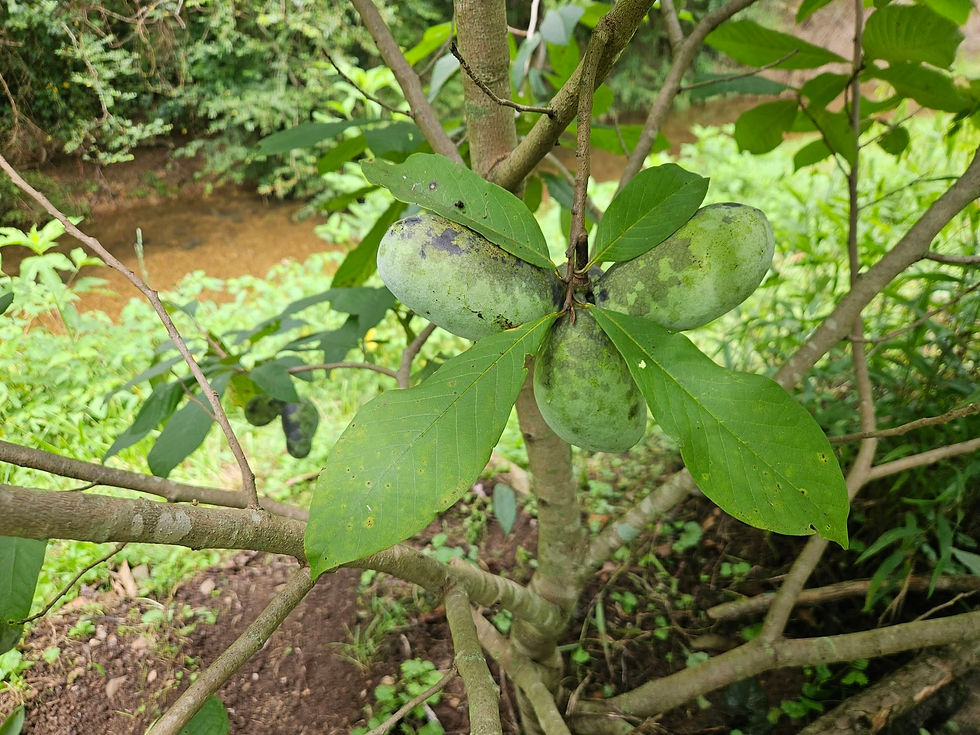
Pawpaw (Asimina triloba) may be a small understory tree, but it produces an impressive fruit that's about the size of a potato. These green fruits have a custard-like texture and a unique taste that may bring to mind bananas and mangos. But it's not easy for humans to get a taste as wildlife are usually the first to arrive when they're ripe. These often spread by root suckers to form colonies or thickets. Some colonies don't produce fruit, however, because they are self-incompatible. A pawpaw flower must receive pollen from flowers on another tree. Pawpaw is the host plant for Tennessee's state butterfly, the Zebra Swallowtail.
I couldn't let September get away without mentioning one of our most rare trees: September Elm. How can you tell if it's a September Elm? Well, for most of the year, you can't. Its bark and leaves are almost identical to other elms. However, all other elms flower and fruit during spring. September Elm (Ulmus serotina) produces flowers in September and then displays its fruit in October and November. If you know where some Winged Elm trees are located, you might find this species in a similar habitat. This medium-sized, rapid-growing tree is found most frequently on moist clay or sandy loam soils, but it also grows on dry, rocky soils of limestone origin. Interestingly enough, in the U.S. this rare species mostly occurs in Middle Tennessee.

September Elm fruits are light-greenish wing-like samaras that turn brown as they ripen in the fall. The seeds are eaten by a variety of birds and small mammals. If you find fresh elm fruit on the ground during the fall, you've likely found the rare September Elm!
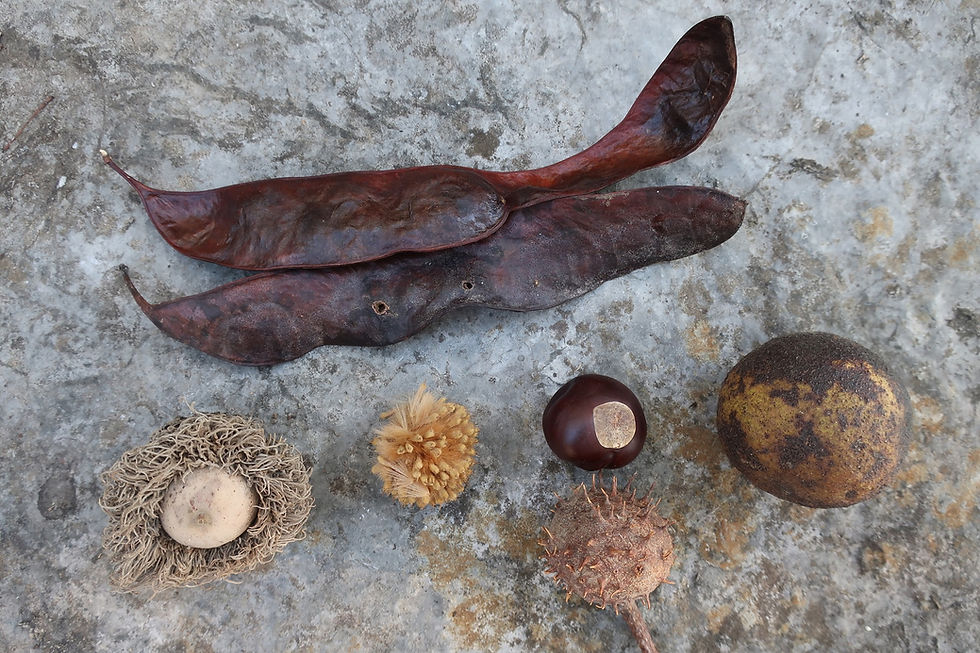
The following photos are some collections of tree fruits that I photographed. Some of these species we have already discussed; others we haven't. Are any of these familiar to you?


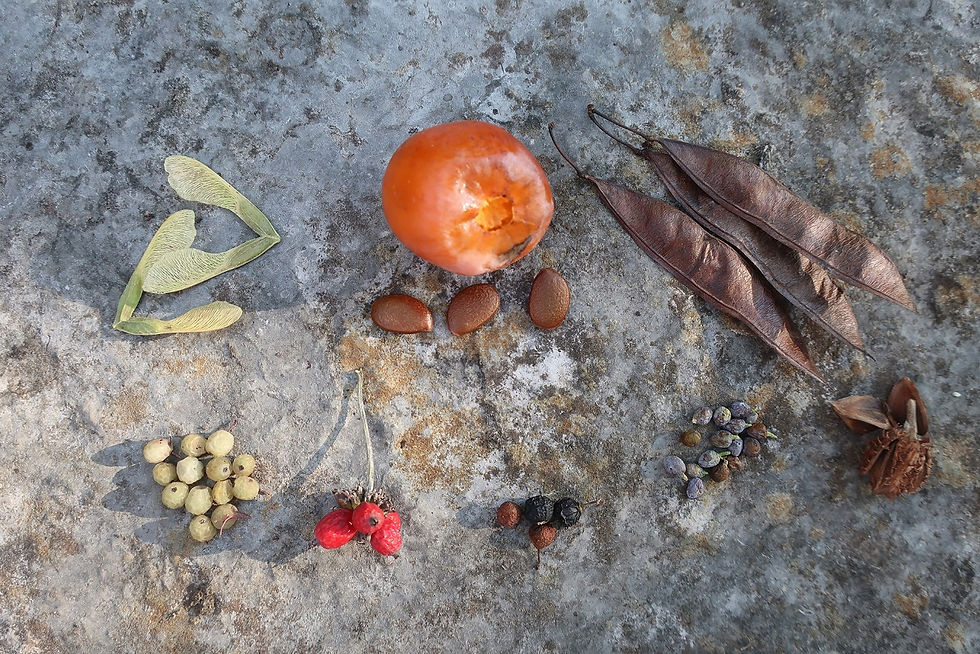

I hope you've enjoyed this discussion of late summer and fall tree fruits found in Tennessee. There are still plenty of tree fruits I haven't photographed yet, and I can't wait to get outside this month and seek out more. I hope you're able to make some interesting tree fruit discoveries as well!
---
In other news, our summer NEST Wildflower ID Class held its final classroom session on Sunday, Aug. 30th, at Middle Tennessee State University in Murfreesboro. Following the class, Leslie Anne led the group over to Flat Rock Cedar Glades and Barrens for a field trip. There will be one last field trip in September.
It's been a wonderful and enthusiastic group of students. Hopefully a lot of wildflowers were learned and many friendships were formed! We're already discussing plans for our next wildflower class, which will likely start in early 2027. Stay tuned for more details...
---
On the first day of September, NEST will travel to at Obed River and Arboretum in Crossville for their "Lunch and Learn" series. Leslie Anne and I will giving a presentation on the cedar glade wildflowers of Middle Tennessee. We can't wait to see everyone in Crossville!
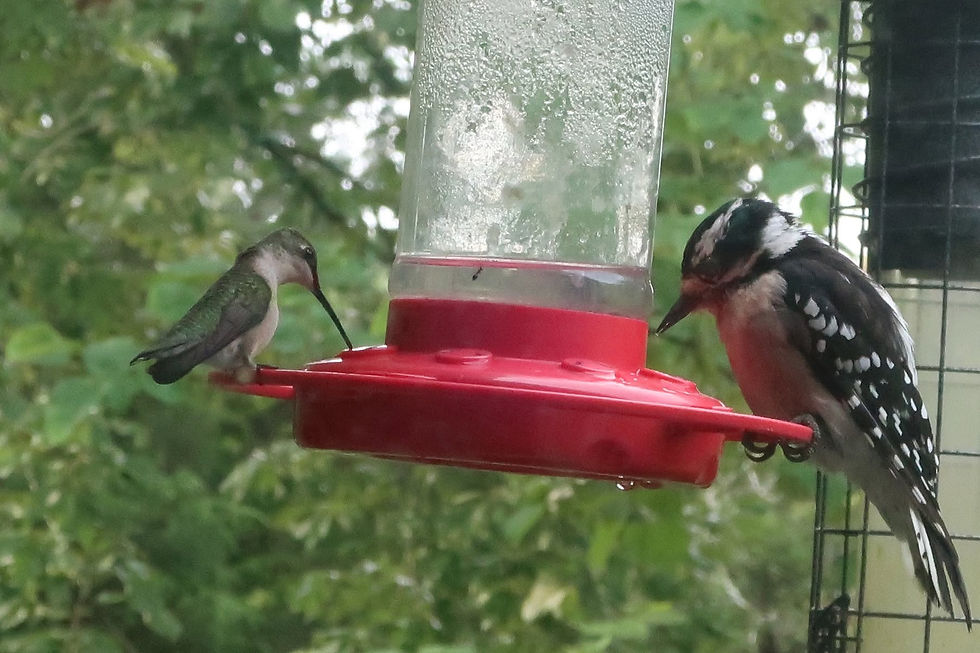
We're also excited to be a part of the Hummingbird Festival in Murfreesboro on Saturday, Sept. 5. The event takes place from 8 a.m. until 3 p.m. and will include hummingbird banding, conservation organization booths, craft booths, speakers, and other activities. There will also be food trucks on site. View the complete schedule at https://www.murfreesborotn.gov/2726/Hummingbird-Festival

On Sept. 24, Leslie Anne and I will give a presentation for the Nashville Chapter Tennessee Trails Association. For this special program, rather than focusing on one particular subject, we plan to discuss “a few of our favorite things.” Topics will include favorite wildflowers, trees, hiking trails, natural areas, birds, frogs, insects, night critters, unusual findings, nature books and movies, wild edibles, and more. You can get additional details at https://tennesseetrails.org/event/nest-presents-natures-greatest-hits/
Last but not least... we're going to the fair! We will be at the Nashville Fair from Sept. 11-20 presenting "Nature's Greatest Hits with Rangers Jason & Leslie." Our show will focus on the flora and fauna of Tennessee. The show will be weekdays at 6 p.m. and 8 p.m. and on weekends at 2:30, 5:30 and 8 at the Nashville Fairgrounds. You can find us at Discovery Forest located inside the Creative Arts Expo building.

In addition to our scheduled fair shows, Leslie Anne and I will be hangin' out at Discovery Forest daily to display our nature collections and connect with fairgoers about the plants and animals of Tennessee. We'd love for some of you to stop by, pull up a log and visit with us. More info about our fair show can be found at https://www.nashfair.fun/events/2026/natures-greatest-hits
Thanks for reading, and we'd like to wish you all a safe and happy and peaceful month of September! All the best,
Jason and Leslie Anne


Thank you LA and Jason. These newsletter are great and so full of good information. See you at the TTA meeting.