
July Sizzle: Fameflowers & Blazing Stars

July isn't for the faint of heart. Even for outdoorsy folks, this is a month when many prefer to stay near water or in the shade. But not all living organisms have the option of cooling off with some shaved ice.
A 98-degree day with the sun bearing down? Brutal conditions, most would say. For some, however, it's paradise. In fact, it is ideal conditions for my favorite wildflower of them all.

Limestone Fameflower (Phemeranthus calcaricus) isn't the biggest nor most showy plant around. You might even say it's downright shy. But in many ways it's the most impressive plant I've seen around these parts. "Bloom where you're planted" is likely its motto.
It typically flowers in the hottest part of the year (summer), during the hottest part of the day (mid-afternoon), with the scorching sun bearing down on its dainty petals, and in the most inhospitable of habitats - the rocky, desert-like cedar glades. It's a plant that seems to defy all the odds.
Its brilliantly colored flowers and buds are held up by a tiny, thread-like stem, and its unusual leaves are rounded and succulent, allowing it to store water during summer droughts.
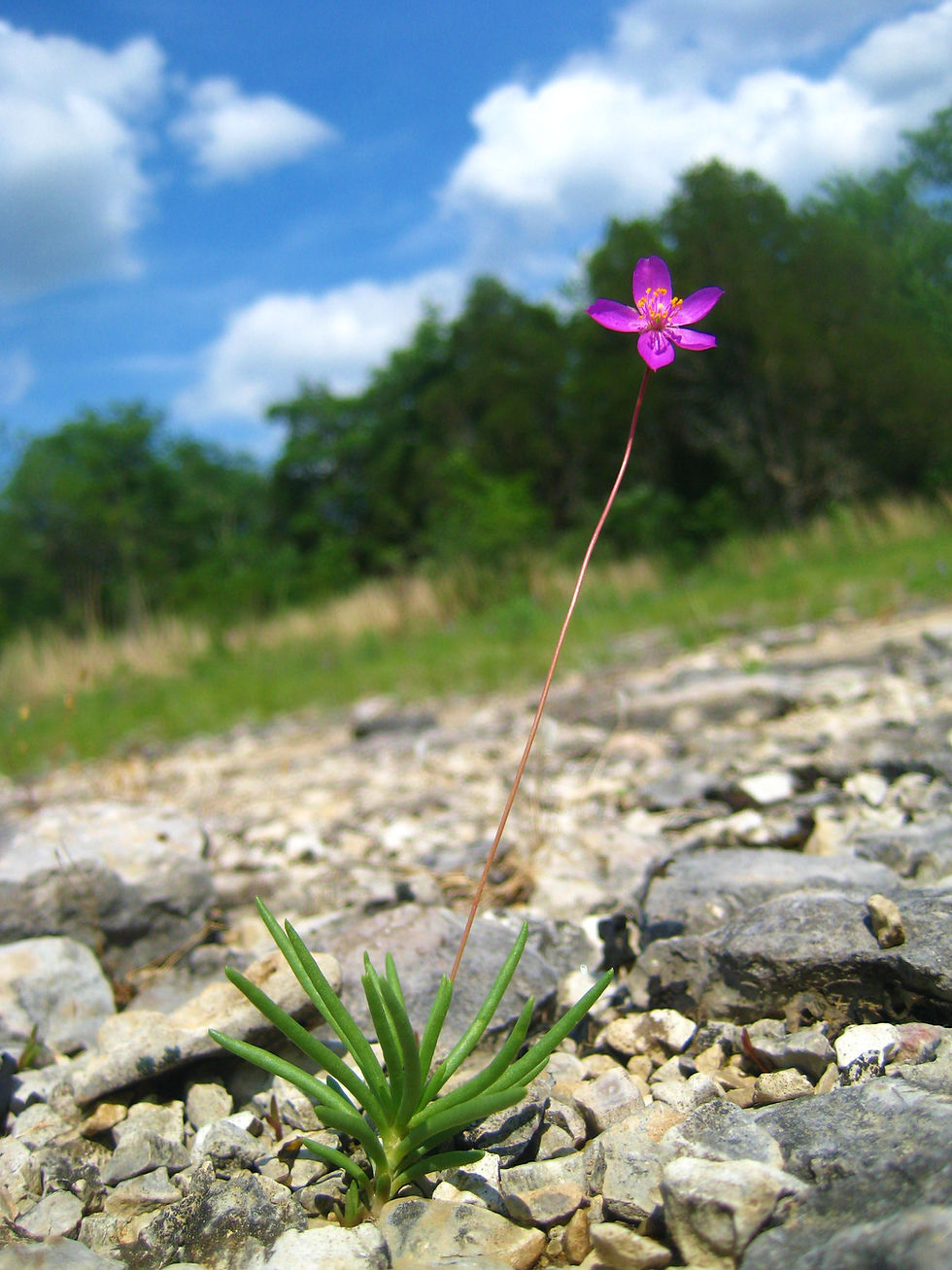
Limestone Fameflower has a surprisingly long blooming season. In my area they flower from May through the end of September. However, they aren't easy to locate because: 1) they are tiny; 2) the flowers are usually closed; and 3) they are uncommon. They are finicky about where they decide to grow, and most cedar glades I've visited don't have fameflowers. But if you're lucky enough to find one, you can often find many nearby.
Its flowers are small - about the size of a dime - and blooms are visible for only a few hours on sunny afternoons. Don't expect to see it flowering if you look in the morning or late evening. For years I've jokingly said that they open at 2:19 p.m. and close at 4:37 p.m. Truth is, that's pretty accurate! I've found the best times to see them in full bloom are on sunny days from 3-4 p.m.

Limestone Fameflower is a cedar glade endemic, meaning that it's found only in these sporadic limestone glade environments. Look for it in the gravelly areas beside exposed, solid slabs of limestone.
I sometimes see it growing near such species as Glade Stonecrop, Round-fruited St. Johnswort and Glade Sandwort. You might also notice Nostoc Commune (aka witches' butter or star jelly) surrounding it.
When fameflowers are closed, you must look closely to spot their tiny, thick green leaves emerging from the thin, rocky soil. But if you find one blooming, you will certainly be rewarded - and possibly in awe of this plant that seems to defy all the odds. I like to call it "the little flower that could."
Have you ever seen a Limestone Fameflower in bloom?
--- --- ---
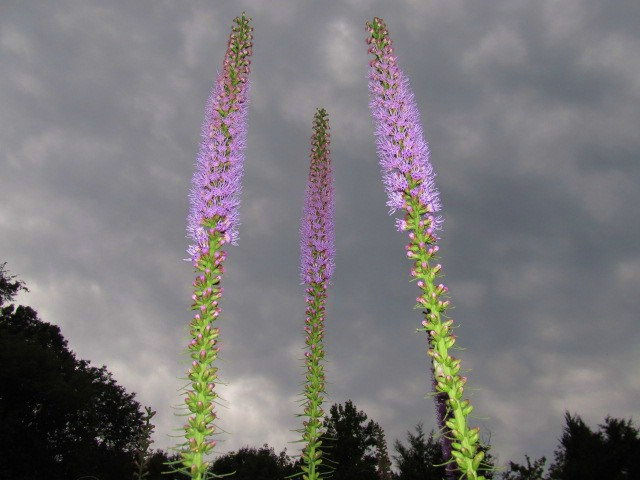
July is also the month for a plant known as the blazing star - a fitting name for the sizzling weather! Also known as Liatris, this tall plant generally grows in the grassy barrens. Seven Liatris species are found in Tennessee.
Dense Blazing Star (Liatris spicata) grows on our property. A couple of other species we have seen in the glades and barrens near us are Southern Blazing Star (Liatris squarrulosa) and Cylindric Blazing Star (Liatris cylindracea).

Blazing stars are perennials that arise from thickened, corm-like rootstock. The leaves are alternate and entire; the lower larger, the upper smaller and usually sessile. The striking flowers are usually pink-purple.
Liatris species are unusual because they flower from the top of the inflorescence down, rather than from the bottom up. They also tend to hybridize, which sometimes makes ID difficult.
Blazing stars and goldenrods once covered large expanses of tallgrass prairie habitat before the conversion of prairies to agriculture in the 1880s.
The corms of some Liatris species were stored as winter food by Native Americans. Liatris has been used in herbal medicine for soothing sore throats and for treating various other ailments. Thus some of its common nicknames: Backache Root, Colic Root, Dense Button Snakeroot, Devil's Bite, Gayfeather, Prairie Pine, and Throatwort.
The blazing stars on our property attract a wide variety of critters, including such butterflies as Eastern Tiger Swallowtail, Monarch, Painted Lady, Gulf Fritillary, Silver-spotted Skipper, Common Buckeye, Delaware Skipper, and Spicebush Swallowtail.

The flowers also attract green lynx spiders, clearwing "hummingbird" moths, bees, wasps, mantises, wheel bugs, and more.
I'm especially fascinated by the green lynx spiders. They hide out on Liatris plants, waiting patiently for butterflies, moths and bees to come close enough to snatch. They are fierce, agile hunters, often catching prey much larger than themselves. Considering the spider's unique coloration and patterns, Liatris is the ideal camouflage. Often the spider's bright green body is perfectly aligned with the stem of the plant, making it virtually undetectable. I've read that females can change their color to fit their background. In other words: Insects, beware!

It varies by species and regions, but in our area blazing stars typically bloom from mid-July through early August. They are worth seeking out - not only for their splendid flowers but also for the incredible parade of insects they attract.
--- --- ---
In addition, July is the month for katydids. I've been hearing them since mid-June, but they have been getting louder in recent days. Their calls typically peak in July.
Katydids are a large group of insects in the order Orthoptera and are related to grasshoppers and crickets. Some katydids have been called long-horned grasshoppers because of their long and slender shape, but katydids are more closely related to crickets. There are about 6,400 species of katydids worldwide.

They are excellent mimics as the green wings of the common true katydid look almost exactly like leaves. They typically stay high up in the treetops and are heard far more often than they are seen.
Even if you never see a katydid, you are certain to hear them on warm summer nights as they rasp their loud mating calls from high in the trees. They make their famous “katy-did-katy-didn’t” call by rubbing their wings together. The sharp edge of the right front wing moves rapidly against a file-like ridge on the left front wing to create the sound.

The call of the katydids is special to me. When I was a kid, my father usually had the windows open on spring and summer nights, and I often fell asleep to the sound of katydids. I found it calming and relaxing. And even now it makes me happy. It's like a free summer concert.
It's also that time of year when our annual cicadas are calling during the daylight hours. Then, suddenly at dusk, the cicadas clock out and the katydids clock in for the night shift. It's one of my favorite transitions in nature.
For me, nothing says summer like the sound of cicadas and katydids.
--- --- ---
As for us here at NEST, we announced our next wildlfower ID class at the beginning of June, and it sold out quickly. We are grateful for the continued interest in this class!
Leslie Anne will be teaching this summer's class at Middle Tennessee State University in Murfreesboro from July 26 through Aug. 30. This is the ninth year she has taught the class. You can get more info about our annual class here: https://www.nest-tn.org/wildflower-classes

We have tried to juggle the class around to different days to give all interested persons a chance to attend. Our spring class was on Saturdays, and this summer's class will be on Sundays. We are considering weeknights for our next one.
This is our last course for this year, but we are hoping to offer another class in early 2027. Stay tuned!
--- --- ---
One of our favorite events from this past month involved a youth summer camp. We taught children about trees at the Stoney Creek Farm Nature Explorers camp in Williamson County.
After our tree discussion, we went for a hike, and the campers chose their favorite leaves - and then made colorful leaf-print bandanas. These kids were so creative! And then at the end of the week, it warmed our hearts as the campers signed one another's bandanas as a keepsake.

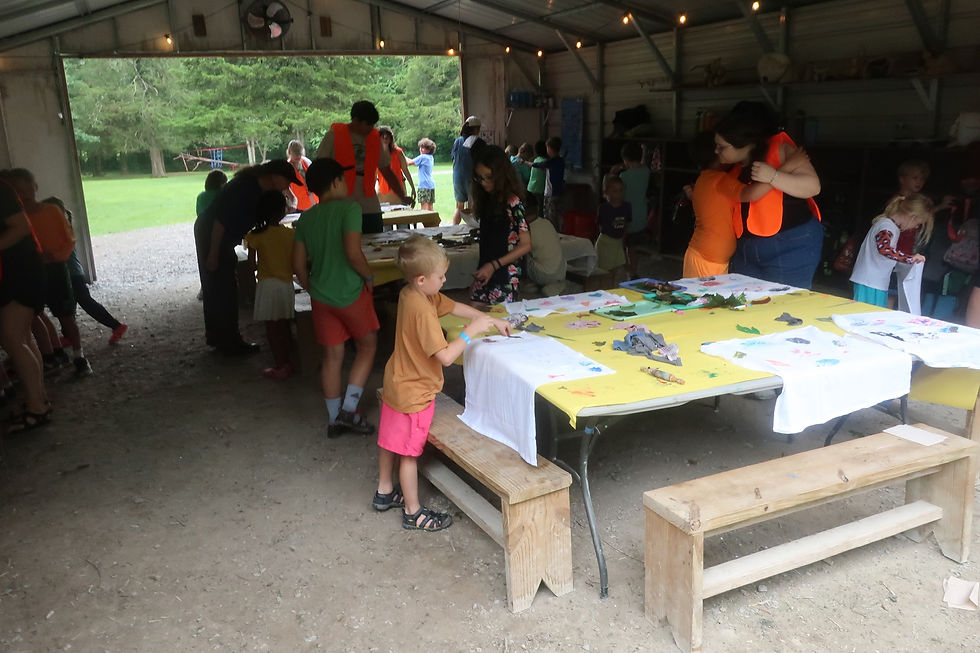

Stoney Creek Nature Explorers Tutorial and Homeschool Enrichment is an all-outdoor, nature-immersive program. We are super impressed by what they are doing to teach kids about nature, farm skills, art, and so much more. You can learn more about them by visiting https://stoneycreekfarmtennessee.com/nature-explorers
Thank you, Stoney Creek, for inviting us to your beautiful outdoor classroom, and we can't wait to explore with you again soon!
--- --- ---
Another highlight for us in June was a hike at Couchville Cedar Glade State Natural Area held for The Nature Conservancy in Tennessee staff and donors. We were honored that they invited us to join them and share our knowledge and experiences.
During our hike, the group was excited to see both Tennessee Coneflower and Prairie Coneflower in bloom. We also saw such species as Glade Savory, Gattinger's Prairie Clover and Maroon Carolina Milkvine. We also did some birding and herping!

We loved hearing stories about the early days of The Nature Conservancy in Tennessee and some of the lands they worked hard to protect.
Did you know that American Airlines flight attendants came up with an idea to recycle aluminum cans on planes and that this project helped pay for the purchase of Couchville Cedar Glade State Natural Area?
Did you know that the rare Tennessee Coneflower was once on the cover of South Central Bell's Nashville phone book?
Did you know that over 80 tons of trash was once removed from the Couchville site?
These were among the items discussed as Nature Conservancy staff passed out articles and handouts to attendees. If you have any interest in cedar glade history, you would likely find some of these old newspaper articles pretty interesting. You can read a couple of the articles here: https://www.facebook.com/groups/hipcedargladesTN/posts/27698033856460213

It was a wonderful gathering and a celebration of sorts. We were so inspired by everyone's enthusiasm and appreciation for special places like Couchville Cedar Glade.
Thank you to The Nature Conservancy in Tennessee for all you do!
--- --- ---
We had a magical Saturday evening in June as we joined Melissa Turrentine and the Nashville Chapter of the Tennessee Ornithological Society to search for nightjars.
We began the evening with a guided tour of the Nature Center garden at Cedars of Lebanon State Park. It is an impressive display of cedar glade species and other plants found in Middle Tennessee.
Then near dusk we got in our vehicles and ventured down a gravel road deep into the cedar forest. We parked beside a spectacular cedar glade, with gravel and bare slabs of limestone surrounding us.
In no time we were hearing and seeing Common Nighthawks, and hearing both Chuck-will's-widows and Eastern Whip-poor-wills. I think we heard all three species within five minutes of our arrival!

The nighthawks were especially entertaining as they swooped down and flew close to our group several times. They seemed utterly fascinated by us. As an added bonus, we got to see their famous maneuver when the male dives sharply toward the ground and then suddenly zooms back upward, creating a dramatic "whooshing" or booming sound with its wings.
We also heard plenty of frogs and got excellent views of the night sky with Venus and Jupiter in clear sight.
This was the second time this year we've been fortunate to hear all three nightjars calling at once. Back in May we led an evening hike at Vesta Cedar Glade where all three species were active and calling.
If you wish to learn more about nightjars (yes, they are still calling!), here's a piece I wrote about them earlier this year: https://www.nest-tn.org/post/nighthawks-chucks-whip-poor-wills-the-return-of-the-goatsuckers
--- --- ---
About three years ago I was hiking in the cedar glades when I noticed a flock of wild turkeys. I don't see many turkeys in the glades, but I didn't think much about it until something caught my eye. Upon closer inspection, I noticed a peacock traveling with them. Unfortunately I wasn't able to get a photo.
Then a couple of weeks ago I was outside in my back yard when I heard something softly approaching. I assumed it was a turkey, but I turned and was surprised to see a colorful peacock. This one was alone, however. I didn't see any turkeys around.
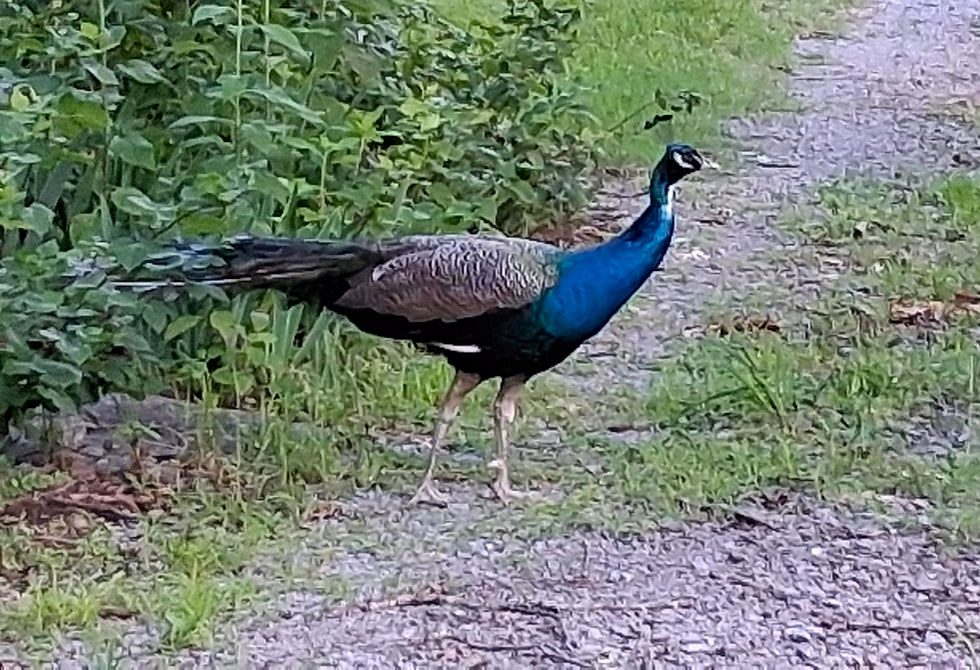
The peacock hung around the yard for a bit, poked around in the grass, and then headed off toward the glades. You just never know what you'll see or hear in the great outdoors.
Happy trails, glade peacock!
--- --- ---
Leslie Anne and I are taking a brief hiatus from NEST programs in July and August to focus on our wildflower class and plan our fall schedule. We already have a busy September lined up and will provide more details in an upcoming newsletter.
The first six months of this year have been deeply fulfilling and rewarding for us. We've had opportunities to lead interpretive hikes, present programs to various clubs and organizations, attend several nature festivals, teach wildflower classes, and educate children about the flora and fauna of Tennessee.

We've met so many wonderful people these past few months. Making connections is what it's all about for us, and we're excited to continue this journey. We look forward to seeing you down the road. And if you have any special requests or ideas, feel free to contact us!
--- --- ---
We hope some of you are able to see a fameflower or blazing star in bloom this summer. Or perhaps hear some nightjars, katydids or frogs. Whatever your pleasure, we hope you stay cool and have a safe and happy month of July.
All the best,
Jason and Leslie Anne


Comments