
Towhees & Woodcocks & Groundhogs, Oh My!

Updated: Feb 2
Happy February, all! Jason here, one half of the NEST team. (The better half, of course, being my wife Leslie Anne.)
Whew... are you glad to see January gone? The ice storm proved difficult for many Tennesseans, and we hope you made it through without too many hardships. For good or bad, it will certainly be one to remember.
It was quite jarring to gaze out our window and see an ice-covered world. It looked more like something we would see in a movie. Beautiful? Perhaps, but I almost hesitate to use that word knowing how much damage it caused for people and trees. Maybe awe-inspiring is a more accurate description. It certainly enhanced my already healthy respect for Mother Nature.

Living in a remote area (and knowing that we would be stuck inside for a while), we found comfort in the wide variety of birds that visited our feeders. They certainly brightened up the cold, gray days.
The hanging feeders attracted our regular chickadees and titmice, while the suet feeder was popular with the woodpeckers and wrens. We tossed mixed seed out for the ground birds and watched as white-throated sparrows, towhees, cardinals and dark-eyed juncos descended. I especially loved seeing a bluebird perched on a tree limb. Its deep blue color was striking with the whitish background of snow and ice.
Speaking of birds... I must admit, I've bonded with one of the towhees. For the past two years whenever I go out onto the porch with bird seed, I make a loud "tweet" whistle. The same male towhee - no matter where he is on our property - always answers back and then approaches the porch, ready for a snack. He doesn't appear wary of me at all and will hop right up to get seeds near my feet.
Honestly, at this point I almost feel guilty when I don't have time to feed the birds. When I get too busy, they'll sometimes come to my window, look inside and give me the evil eye. Or else a sad face. They know I'm a pushover.
***
A couple of weeks before the ice storm hit, I was thrilled (and a bit surprised) to find my first wildflower of 2026: Long-styled glade cress (Leavenworthia stylosa). I found a single flower blooming at Couchville Cedar Glade State Natural Area in Davidson County.
Long-styled glade cress is a rare species in the Mustard Family. In the U.S., it occurs only in Middle Tennessee, mainly in the limestone glades of Davidson, Rutherford and Wilson counties. It gives off a nice honey-like aroma, and the flowers can be white, yellow or pinkish.
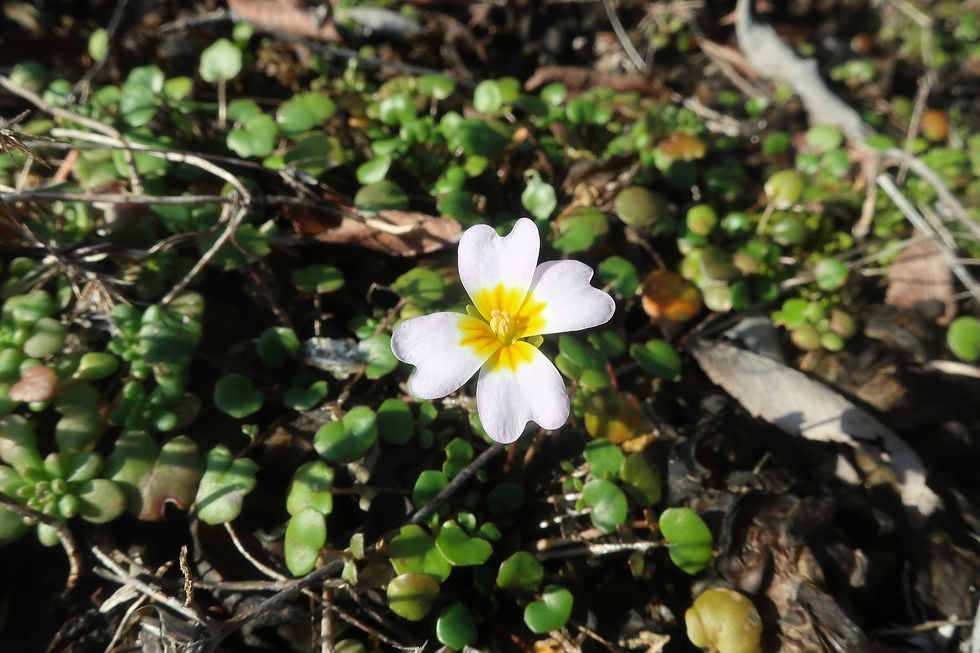
Is this considered an early bloom? Most definitely, although I have seen this species flowering in January before. This is the earliest glade cress flower I've seen since 2013, when I found one flowering on Jan. 8th. Last year I didn't discover the first bloom until Feb. 18th. But don't be too concerned about this particular species flowering too early. It's a tough little plant. In past years I've seen it flower early, get covered in snow, and then - just a couple of days later - poking out from the snow and blooming once again.
By the way, you have plenty of time to see glade cress flowering. It normally doesn't peak until March, and it often blooms through April. It is worth seeking out.
***
Much like January, there aren't a lot of wildflowers and wildlife to see in February other than the birds at your feeders. However, there are a few to keep in mind. One is the unusual bird known as the American woodcock (Scolopax minor).
This odd-looking little shorebird has a plump, rounded body, an extremely long bill (which helps it find earthworms in the soil), and large eyes located high atop the back of its head. But it's probably best known for its acrobatic aerial courtship display.
Near dusk, the male woodcock gives a buzzy "peeeent" call from the ground, and then flies upward in a wide spiral. As he gets higher, his wings make a high-pitched "twittering" sound. Once it attains a height of 200–400 feet, the twittering becomes more intermittent as the bird descends, zigzaging downward, chirping as he goes, then landing silently - hopefully near an impressed female! Once back on the ground, the male woodcock resumes its "peeeent" and the display starts all over again.

In Tennessee, if you live near open fields, cedar glades or forest openings, you might listen for male woodcocks near dusk in February and March. Last year I heard the first one on Feb. 6th. If you ever get to see and/or hear this magical display, you will likely never forget it.
If you're interested in experiencing the courtship displays of these fascinating birds, you might keep an eye out to see if any local parks or organizations have "Woodcock Watch" events. Last February Bells Bend Park in Nashville had several such programs.
The woodcock is also known as the timberdoodle, Labrador twister, night partridge, and bog sucker.
***
Keep an ear out in February for the upland chorus frog (Pseudacris feriarum). In my area it is the first frog I hear each year. In fact, I've already heard a few this year during our brief warm spell in early January. But February and March are when they REALLY become active and vocal. The best locations to hear them are near streams, ponds, swampy areas, and moist woods.
Their unique call, described by some as the sound of someone rubbing their finger across the teeth of a comb, makes them easy to identify by sound. During warm weather in late winter and early spring, their vocalizations often fill the air at night.
Chorus frogs are small, well camouflaged (brownish or grayish), and rarely seen. They can get loud, but don't expect to see one. Just sit back and enjoy the free concert.
***
Let's not forget about the trees. Winter is my favorite time of year to study tree bark. Over the years I've learned to identify many species by simply inspecting the bark. Furthermore, now that the leaves have fallen, you can get a good look at the overall sizes and shapes of trees and get a feel for their habitat. If you're interested, here's a winter bark study I did not long ago: Ranger Jason's Nature Booth - Winter Trees.
February is an ideal time to study tree buds and notice their subtle differences. This can be one way to help identify trees when bark, leaves and fruit don't provide a definitive answer. During mild spells you might see some buds bursting open in February, especially maples and elms. Last February I found flowers on both silver maple and winged elm trees.

In February you might also see some of last year's fall fruit still hanging onto the trees. The eastern redbud in our front yard still has several of those long, flat brown seed pods attached. These fruits contain bean-like seeds which are a valuable food for wildlife during the winter.
The fruits of eastern redcedar are also visible during the winter. These pale blue fruits, which are actually a type of cone, occur on female trees and are an important winter food for many songbirds, which disperse the wingless seeds.

As for foliage, you probably won't see any new leaves in February. But you might find some old leaves still hangin' around from last year, especially on oak species.
Why do leaves stay on certain trees for so long? This is known as winter leaf marcescence. This comes from the Latin “marcescere” which means “to fade,” and this process allows brown leaves to stay attached to some trees longer than others. Although it varies, you’re more likely to see this in younger trees and on the lower branches of more mature trees.
So why does this process occur? Some suggest that it prevents deer or other animals from browsing the trees. For instance, deer may choose to ignore these dry, bitter, old brown leaves in favor of fresh buds and twigs. Others propose that when brown leaves finally drop during the spring, it provides mulch around the tree which helps conserve moisture - and then when they decompose, they provide important nutrients for growth.
Recently I took a walk in the woods behind my home to investigate. Aside from the evergreen eastern redcedars, most of the trees I saw were bare. One particular species, though, stood out in that almost all of them still held leaves: eastern hophornbeam (Ostrya virginiana). Most of these are small understory trees, and for years I’ve noticed that they retain their leaves longer than just about any other species in my area.

I also noticed the smaller sugar maple trees still held many leaves, while the larger specimens were mostly bare. Similar story with post oak: The smaller trees had leaves, while the larger ones were mostly bare - although some of the larger trees retained leaves on their lower branches.
Oaks are well known to retain their leaves into the winter months, and I noticed several large specimens (mostly red oaks) still holding onto their leaves. Beech is another species that often practices marcescence.
What are you seeing in your area? Which trees still have leaves? I look forward to investigating again in February to see if there are any "old" leaves still out there.
***
It's been a busy few months for Leslie Anne and I getting our new NEST venture off the ground. But it's also been deeply fulfilling.
We made our first appearance as NEST back in October at the Conservation in Action Expo in Murfreesboro. Big thanks to Outdoor Murfreesboro's Lauren May for inviting us to participate! A couple of weeks later we teamed up with TennGreen Land Conservancy (thanks for the invite, Nichole Hidalgo Jordan!) for an exploratory hike at Lamar Cedar Glade.

Then came December, and we had a LOT of forms to fill out and paperwork in order to make NEST an official LLC. We wish to thank Leslie Gossett Whalen of School of Earth and Awe for her knowledge, wisdom and suggestions during this process.
In January we created a website to go along with our social media pages. Our friend Scott Pessoni of Gemini Production Group was a big help to us with his technical advice. Thank you, Scott! Then we started planning for 2026.
Our first big event of 2026 is the NEST Wildflower ID Class taught by Leslie Anne. She has been teaching wildflower classes for many years, and (yes, I'm a bit biased) no one does it better.
This year's wildflower classes will take place at Middle Tennessee State University in Murfreesboro. This college-level course includes more than 24 hours of instruction, a notebook and handouts, light snacks, and a field notebook upon completion of the course. The classes were scheduled to begin on Jan. 31st, but due to the recent ice storm and power outages the first session has been pushed back to Saturday, Feb. 7th.
As of this writing, the class still has a couple of spots open. If you are interested, you can get more details or sign up at https://www.nest-tn.org/wildflower-classes

Many thanks to Kim Sadler and MTSU's Center for Environmental Education for helping us to coordinate these wildflower classes. We also wish to thank our dear friends Rebecca Pond and Christa Ellis, who have given so much of their time in recent months to provide feedback and support. We couldn't have gotten this far without the help of so many wonderful friends and supporters. We are appreciative for each and every one of you.
We're also grateful (and excited) to be receiving so many requests for programs and presentations in 2026. It has been so much fun filling in our new calendar!
In the coming weeks we are scheduled to do presentations for Master Gardeners of Rutherford County, Tennessee Native Plant Society, Wilson County Master Gardeners, and Master Gardeners of Davidson County, and we have already scheduled hikes with Outdoor Murfreesboro (for their Earth Week Outdoors event) and TennGreen Land Conservancy, among others. For more details on upcoming programs and presentations, visit our NEST website and go to "Upcoming Events."

We're also pleased to announce that we are officially a vendor for Metro Nashville. This means we will be among those eligible to present programs for Nashville schools and libraries and other Metro Nashville events. We hope to make similar arrangements with other surrounding counties. If your school or library would like an environmental education program, feel free to reach out!
Over the years I've had quite a few people ask if I would come to their property and help identify a tree or wildflower. This got me to thinking, and that's an aspect we've decided to incorporate into NEST. We recently got our first request for this service, and we are excited to explore this property and see what we find. It should be a fun adventure both for us and the homeowner. If you need help identifying flora and fauna on your property, let us know!
***
Well, Groundhog Day is upon us. I've always enjoyed this particular day (and I also love the Bill Murray movie), but it's especially meaningful to me for a couple of reasons.
First, my barn has been home to a groundhog (his name is Rudy) for several years. Most folks wouldn't want a groundhog living in their barn. Yes, they can be destructive. Rudy dug a huge hole in the back of the barn. But since then, he's calmed down and been pretty satisfied with his rustic abode. We even provided him with his own "Groundhog Crossing" sign above the barn door - just so the other wildlife will know who lives here. Before the cold weather hit this winter, we enjoyed seeing Rudy in our back yard, fattening up on acorns from the chinkapin oak trees. Rudy and I have that in common: We both like food.

Groundhog Day is also special to me because it's my wedding anniversary. Leslie Anne and I were married beside Spring Creek in Wilson County on a sunny 65-degree Groundhog Day in 2024. There were even a couple of groundhogs in attendance. Also, in honor of the movie Groundhog Day, we got married to Sonny & Cher's song "I Got You Babe." We decided that if one day was going to repeat itself over and over (like in the movie), this would be the perfect day. So Groundhog Day will forever be special to us.
Whether Punxsutawney Phil sees his shadow or not, we hope your February is filled with warmth, joy, happiness and peace. We appreciate you joining us on this journey, and we hope to see you soon.
All the best,
Jason and Leslie Anne (and Rudy)


A lot of work and valuable information. Thank you!
Thank you!